IELTS Writing Task 2: A Practical Structure for Higher-Band Essays
November 11, 2026 2026-11-11 18:18IELTS Writing Task 2: A Practical Structure for Higher-Band Essays
By Muhammad Ghaznavi · Updated November 10, 2026
Many IELTS candidates know English well but still lose marks because their essays are difficult to follow. A reliable structure makes your position, ideas, explanations, and examples easier to identify.
For IELTS Writing Task 2, you need to write at least 250 words in about 40 minutes. The strongest plan is simple: answer the question, develop two clear ideas, and finish with a direct conclusion. Use the structure as a framework, not as a memorised essay.
Key Takeaways
- IELTS Writing Task 2 requires at least 250 words and takes about 40 minutes (official IELTS test format, 2026).
- The complete Writing test lasts 60 minutes and contains two tasks, with Task 2 carrying twice the weight of Task 1 (IELTS, 2026).
- A practical essay uses an introduction, two developed body paragraphs, and a conclusion.
- Every body paragraph should contain one main idea, an explanation, and a relevant example.
- Reserve about five minutes to check your answer before time ends.
What Is the Best IELTS Writing Task 2 Structure?
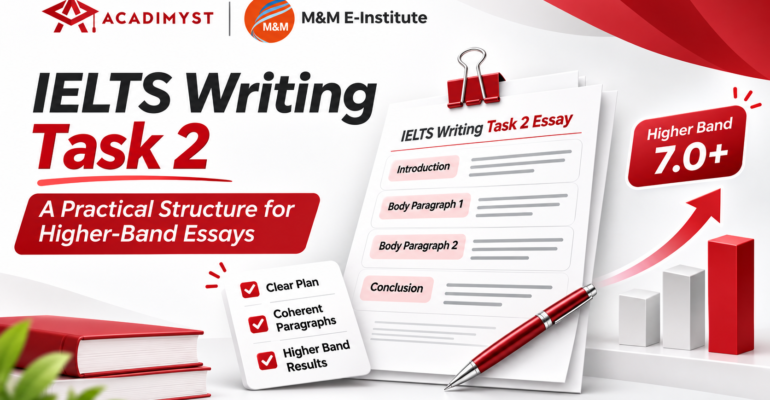
IELTS Writing Task 2 requires at least 250 words and about 40 minutes, so the best structure is compact and repeatable (IELTS, 2026). Use four parts: an introduction, two developed body paragraphs, and a conclusion. This gives you enough space to answer the task without losing control of time or language.
The four-part framework
Use this basic plan for most IELTS Writing Task 2 essays:
- Introduction: Paraphrase the topic and give your answer or position.
- Body paragraph 1: Present your first main idea, explain it, and give an example.
- Body paragraph 2: Present your second main idea, explain it, and give an example.
- Conclusion: Summarise your position without adding a new main idea.
This structure works because each paragraph has a separate job. The introduction tells the examiner what you think. The body paragraphs develop your reasoning. The conclusion confirms the answer. IELTS explicitly expects full, connected writing rather than notes or bullet points in the examination response (official IELTS Writing criteria); the numbered framework here is only for planning.
As a personal practice target, you might aim for around 260 to 290 words. The official minimum is 250 words, not a mandated upper range (IELTS Academic Writing test format). Writing much more can reduce the time available for checking, so prioritise developed ideas over length.
A simple planning formula
Before writing, spend four or five minutes identifying three things:
- What exactly is the question asking?
- What is your position?
- Which two ideas best support that position?
Choose ideas that you can explain clearly. A simple idea with a specific explanation is stronger than an ambitious idea that you cannot develop accurately.
For example, if the question asks whether schools should teach financial skills, you might choose budgeting and responsible borrowing. Both ideas can be explained through students’ future lives without requiring invented research or complex vocabulary.
How Should You Write the Introduction?
The introduction should answer the task immediately. IELTS uses four writing criteria, and Task Response considers how fully you answer the question and how clearly you present your position (IELTS Writing preparation resources, 2026). In most essays, two focused sentences are enough: one paraphrase and one thesis statement.
Sentence 1: paraphrase
Rewrite the question using different grammar or vocabulary. Do not replace every word with a difficult synonym. Your paraphrase must preserve the original meaning.
Question: Some people believe that university education should be free for everyone. To what extent do you agree or disagree?
Paraphrase: Some people argue that all students should be able to attend university without paying tuition fees.
The paraphrase shows that you understand the topic. It is not the main answer, so do not spend too much time making it sound impressive.
Sentence 2: thesis statement
Your thesis statement gives your direct answer. It can also preview the reasons you will explain in the body paragraphs.
Example: I partly agree with this view because free university education can improve access, although governments must also protect public funding for essential services.
For an opinion essay, make your position unmistakable. Avoid vague phrases such as “this issue has both advantages and disadvantages” when the question asks what you think.
For a discussion essay, mention both views and state your opinion. The examiner should understand your position by the end of the introduction, not only in the conclusion. Official IELTS guidance recommends identifying and answering each part of the prompt (IELTS question-prompt advice).
How Do You Build a Strong Body Paragraph?
A strong IELTS Writing Task 2 body paragraph presents one main idea, explains its importance, and supports it with a relevant example. The official IELTS Writing assessment criteria evaluate how well ideas are developed, supported, and organised. Using the PEEL method can help candidates produce clear, coherent paragraphs.
The PEEL paragraph method
A practical body paragraph can follow PEEL:
- Point: State the main idea in a clear topic sentence.
- Explanation: Explain why the idea is true or important.
- Example: Give a specific, realistic example.
- Link: Connect the example back to the question.
Model paragraph:
One major benefit of free university education is that it can widen access for students from low-income families. When tuition fees are removed, capable students may be able to continue their studies instead of entering low-paid work immediately after school. For example, a student who cannot afford a private loan could study nursing or teaching and later contribute to an essential public service. Therefore, free education can reduce financial barriers and support a more skilled workforce.
Notice that the paragraph has one main idea. The example is not random. It explains how the idea could work in real life.
Developing examples effectively
Your examples can come from your knowledge or experience; official IELTS sample Task 2 instructions explicitly allow this (IELTS Academic sample tasks). You do not need invented statistics. Make each example relevant and believable. You can use a country, a group of people, a workplace, a school, or a typical situation.
Avoid examples that are too broad:
“This is good for society because many people benefit.”
Make the example specific enough to prove the point:
“For instance, flexible evening classes can help full-time workers gain qualifications without leaving employment.”
After writing an example, ask yourself: How does this prove my main idea? If you cannot answer, the example probably needs more explanation.
One way to check development is to underline your topic sentence, circle the supporting explanation, and box the example. If you cannot identify all three, revise the paragraph before adding more vocabulary. This is a practice technique, not an official IELTS marking formula.
A practical before-and-after revision
Underdeveloped point: Online lessons are helpful because students can study from home.
Improved point: Online lessons can help students who live far from a college because they remove the need for a daily commute. For example, a learner in a rural community could attend a live lesson without travelling to a city, provided they have a reliable internet connection.
Why the revision is stronger: The second version identifies who benefits, explains the mechanism, and uses a realistic illustrative example. This is an original teaching example, not a claim about actual student results. IELTS Task Response rewards ideas that are relevant, extended and supported (official IELTS Writing resources).
How Should You Organise Different Question Types?
Match your essay plan to the exact Task 2 question, which may ask for an opinion, discussion, response to a problem, or answers to more than one question. IELTS advises checking every instruction before writing and addressing all parts of the prompt (official IELTS question-prompt advice). Adapt the body paragraphs instead of forcing every essay into a memorised template.
Opinion essays
For “To what extent do you agree or disagree?” questions, state your position clearly in the introduction. Each body paragraph should support that position.
A useful plan is:
- Introduction with your opinion
- Reason 1 supporting your opinion
- Reason 2 supporting your opinion
- Conclusion confirming your opinion
If you partly agree, explain both sides carefully. Do not say that you agree “to some extent” and then write an essay that supports only one side.
Discussion essays
For “Discuss both views and give your own opinion” questions, give each view a separate body paragraph. Your conclusion should make your opinion clear.
- Introduction with both views and your position
- Body paragraph explaining View 1
- Body paragraph explaining View 2 and your opinion
- Conclusion summarising the discussion
You can place your opinion in either body paragraph, but keep it consistent. The examiner should not have to guess which side you support. In the official Task 2 band descriptors, a clear position and well-supported ideas are part of stronger Task Response performance (IELTS band descriptors, updated May 2023).
Problem-solution and two-part essays
For problem-solution questions, use one paragraph for the main problem and another for the best solution. If the prompt asks for several problems or solutions, use clear topic sentences to show the relationship.
For two-part questions, answer both questions directly. Do not spend the whole essay answering only the first part. Two developed points are usually better than a long list of undeveloped ideas.
What Language Helps You Reach a Higher Band?
Higher-band writing uses accurate, appropriate vocabulary and well-controlled grammar rather than difficult words for their own sake. Official IELTS band descriptors assess lexical precision, sentence variety, and grammatical accuracy (IELTS Writing band descriptors). Use words and structures that make your argument clear, then edit for repeated errors, awkward collocations, and imprecise meaning.
Vocabulary choices
Use vocabulary that fits the topic and your meaning. For an essay about online education, useful phrases may include:
- access to educational resources
- flexible learning arrangements
- digital skills
- face-to-face interaction
- unequal internet access
Use each phrase because it expresses a precise idea. Avoid inserting memorised expressions such as “in this modern era” or “this topic has attracted widespread attention.” These phrases often add no meaning.
Word partnerships also matter. Say “make a decision,” “provide access,” and “reduce inequality” rather than creating unusual combinations from a dictionary.
Grammar and sentence control
Use a mixture of simple, compound, and complex sentences. IELTS assesses grammatical range and accuracy as a separate criterion, with equal criterion weighting within each task (IELTS scoring in detail). A complex sentence can show a clear relationship between ideas:
Although online courses are convenient, some learners need classroom support to remain motivated.
Do not make every sentence complex. Short sentences can emphasise an important point and reduce errors. Accuracy is more valuable than constant grammatical risk.
During practice, focus on one recurring error at a time. Check articles, subject-verb agreement, verb tense, or countable nouns. Keep a short personal error list and use it in your next timed draft; this is a practical revision exercise rather than a proven scoring guarantee.
How Can You Check Your Essay in the Final Minutes?
Reserve roughly five minutes to check your IELTS Task 2 essay for a complete answer, logical paragraphs, grammar, spelling, punctuation, and the 250-word minimum. The IELTS Writing test lasts 60 minutes, and official guidance recommends spending about 40 minutes on Task 2, which counts for two-thirds of the Writing mark (IELTS Writing preparation resources).
A five-minute editing checklist
Minute 1: Task response
Check that you answered every part of the question. Confirm that your opinion is clear and consistent.
Minute 2: Paragraphing
Make sure each paragraph has one central idea. Check that the introduction and conclusion do not contain major supporting arguments that belong in the body.
Minute 3: Grammar
Look for missing verbs, incorrect tenses, subject-verb agreement, articles, and plural endings. Correct obvious errors first.
Minute 4: Vocabulary and spelling
Check repeated words, spelling mistakes, and unnatural phrases. Replace a difficult word only if you are certain the replacement is accurate.
Minute 5: Word count and punctuation
Confirm that you have written at least 250 words. Check full stops, commas, capital letters, and sentence boundaries.
During practice, use a different coloured pen to record repeated mistakes. Over several essays, this creates a personal error list. You can also use the IELTS mock-test resource to practise planning, timing, and review under realistic conditions.
What Mistakes Lower IELTS Writing Task 2 Scores?
IELTS Writing Task 2 responses can lose marks when they overlook part of the prompt, leave their position unclear, repeat unsupported ideas, or use inaccurate language. IELTS specifically advises test takers to answer all prompt parts, support ideas with relevant examples, and avoid memorised essays (official IELTS question-prompt guidance). Prioritise relevance, development, and clarity.
Content mistakes
Avoid these problems:
- Repeating the question instead of answering it
- Giving an opinion without explaining why
- Adding examples that do not support the paragraph
- Discussing a related topic rather than the exact question
- Writing a conclusion that introduces a new main idea
The most common structural mistake is confusing length with development. A 350-word essay can still be weak if the ideas are repeated. Focus on relevance and explanation.
Language mistakes
Do not force idioms, rare vocabulary, or memorised introductions. Examiners reward communication, not decoration. A sentence such as “This issue is a double-edged sword in the modern world” may sound familiar, but it does not answer the question.
Instead, write directly:
“This policy could reduce costs for families, but it may place pressure on public budgets.”
Direct writing gives you more space to explain your actual argument. It also makes grammar easier to control.
About the Author
About the Author – Muhammad Ghaznavi
Muhammad Ghaznavi is an EdTech Founder, Educator, Teacher, Professional Trainer, and Education Management Leader. He serves as the Managing Director of M&M E-Institute and is the Founder of MM Coding Lingo, focusing on innovative educational solutions, technology-driven learning, and professional skill development.
With experience in education management, teaching, training, and educational technology, he is passionate about empowering students and professionals through accessible, practical, and results-oriented learning experiences. His areas of interest include IELTS, PTE, OET preparation, English language training, digital education, AI-powered learning solutions, and educational innovation.
Professional Profile: Muhammad Ghaznavi on LinkedIn
Editorial review: Updated November 10, 2026. This article is informed by official IELTS test-format guidelines and assessment resources to provide learners with practical, reliable, and well-structured guidance. The author does not claim to be a certified IELTS examiner or to have personally assessed the sample essays.(https://mmeinstitute.com/contact/).
Conclusion
A high-band IELTS Writing Task 2 essay does not need a complicated format. It needs a clear answer, two developed ideas, accurate language, and logical organisation. Use the four-part structure, plan before writing, and reserve five minutes for checking.
Start by practising one question type at a time. Write under the 40-minute limit, review your recurring errors, and ask for feedback on Task Response as well as grammar. For a guided course option, explore M&M E Institute’s IELTS Academic preparation. The structure and practice methods above can also be used independently of a paid course.